Prices are rules
Resolve never stores a bare price. Every price is the result of a rule — a small piece of pricing logic attached to a product (or a group of products), a location, and a price list. When you look at a price in Resolve, you are looking at a rule being evaluated at that moment.
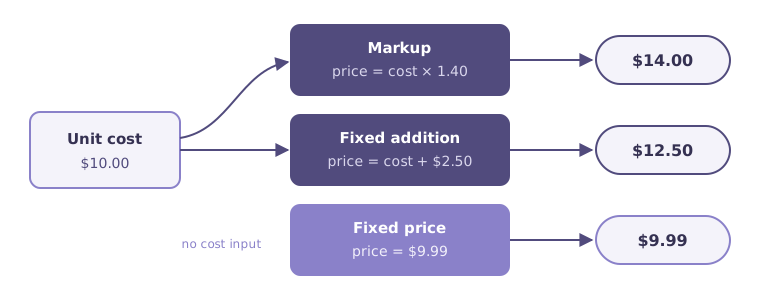
The three rule types
| Rule type | What it says | Example |
|---|---|---|
| Markup | Price is a multiple of cost | cost × 1.40 |
| Fixed addition | Price is cost plus a set amount | cost + $2.50 |
| Fixed price | Price is exactly this number, regardless of cost | $9.99 |
Markup and fixed-addition rules are cost-pegged: when the unit cost of a product changes, the price follows automatically — no re-pricing project, no stale margins. A fixed price stays put no matter what costs do, which is what you want for psychological price points and contractual prices.
A rule can also mark a product as not offered in a given scope, which removes it from sale there without touching the rest of the range.
The pricing unit: Product × Location
Every price in Resolve is scoped to a product at a location. The same product can carry different rules in different stores or regions — and the same rule can cover one location or all of them. Combined with price lists (the customer dimension), the full address of any price is:
product × location × price list
Prices are computed when you look
Because prices are rules, Resolve resolves them at read time. There is no overnight batch that materialises prices, and no risk of a stored price drifting out of date. Change a rule, and every grid, export, and impact figure reflects it immediately.
Prices can be scheduled
Every rule carries a valid from date — the moment it takes effect. This is how you stage future price changes: a rule dated next Monday sits alongside today's rule, visible in the grid as a scheduled price, and takes over automatically when its time comes. Price timing is decided to the minute.
Why this matters
- Consistency — one category-level rule prices hundreds of products the same way, instead of hundreds of independently-maintained numbers.
- Responsiveness — cost changes flow through cost-pegged rules the moment they land.
- Auditability — every price traces back to the rule that produced it, who wrote that rule, and why. See Reviewing prices.
Next: how rules cascade through your catalogue — Hierarchy & inheritance.