Assessing impact
Before a scenario's prices reach anyone, Assess Impact quantifies what they would mean: the revenue and profit change had the new prices applied to the last twelve months of your actual sales. It appears in the menu whenever a scenario is active.
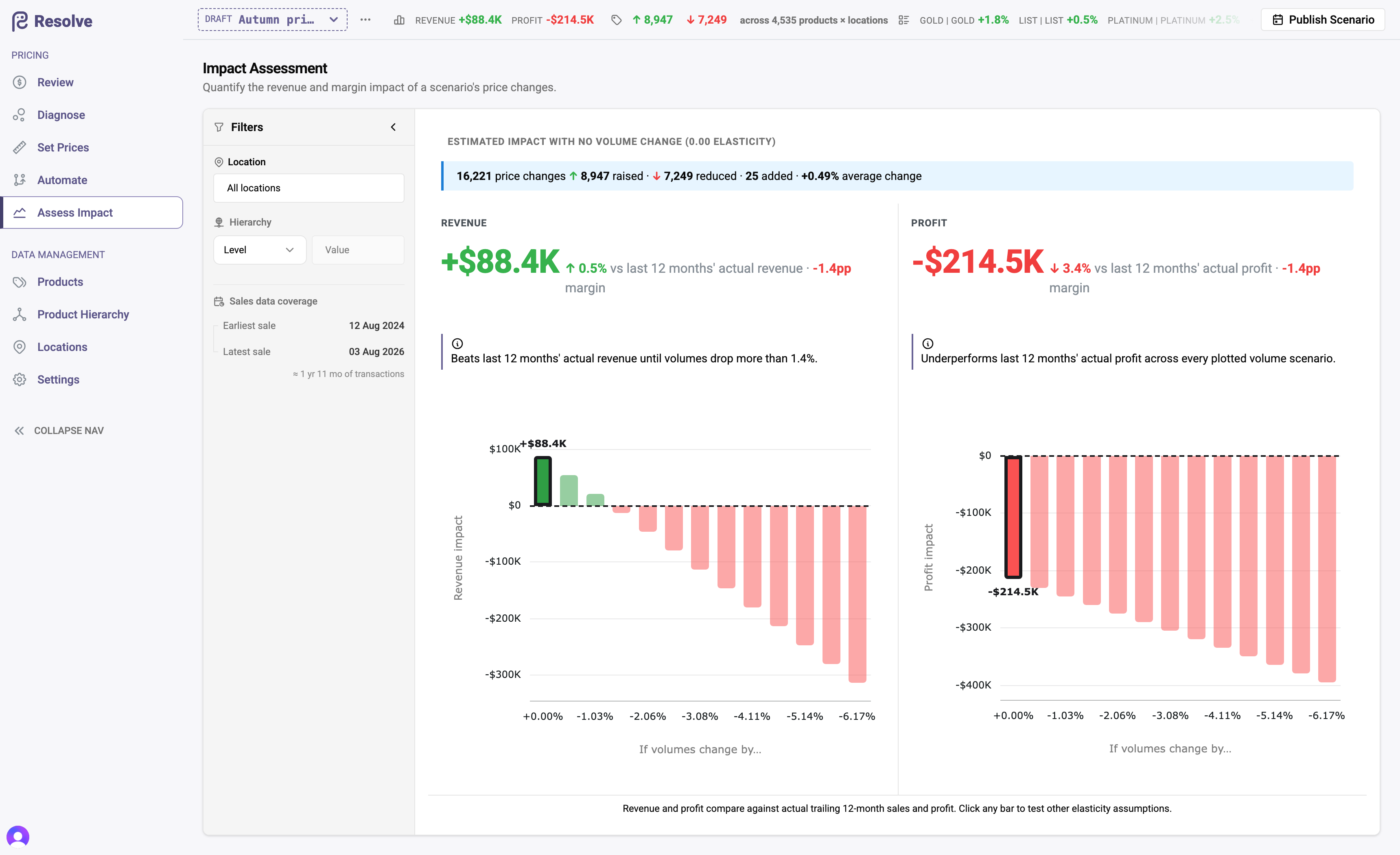
What it shows
- Revenue and profit deltas — scenario versus Live, computed against actual sold volumes: every unit you sold in the last twelve months, repriced at the scenario's prices.
- Break-even movement — for changes that trade margin against volume, how much volumes would have to move before the change stops paying. A price cut that "beats the current price until volumes rise more than X%" is a very different conversation from one that needs volumes to double.
- Quantity impact estimate — an adjustable estimate of how demand may respond, so you can see impact under assumptions you choose rather than a black-box forecast.
Filter all of it by location, hierarchy level, or a specific category to see where the impact concentrates — a scenario that is flat overall may hide a significant giveaway in one category funded by increases in another.
The always-on summary
You don't need to open the page for the headline: whenever a scenario is selected, the toolbar shows its running impact summary — revenue and profit change versus Live and average price movement per price list — updating as you edit. Assess Impact is the drill-down when a number in that summary raises an eyebrow.
Impact reads history, not the future
The twelve-month baseline answers "what would last year have looked like at these prices?" — a factual, assumption-light comparison. It deliberately does not model competitor response or demand shifts beyond the quantity estimate you control. Treat it as the floor of your understanding: precise about the mix you actually sold, honest about what it doesn't predict.
Make impact review a publish gate
The toolbar summary makes it cheap to glance at impact after every meaningful edit; the page makes it cheap to justify a scenario in a pricing meeting. Teams that require an impact screenshot in their publish sign-off catch giveaway errors before customers do.
Once the result passes review, follow the publishing workflow to carry the scenario to Live.